Technological Institute of Aeronautics
São José dos Campos - São Paulo - Brazil
|
|
Technological Institute of AeronauticsSão José dos Campos - São Paulo - Brazil Requirement 1: Landing Field Length (LFL) |
 Background
JAR 25.125 Landing.
(a) The horizontal distance necessary to land and to come to a complete
stop from a point 50 feet above the landing surface must be
determined ... as follows:
(1) The airlane must be in the landing configuration.
(2) A stabilized approach, with a calibrated airspeed of not less than 1.3
VS, must be maintained down to the 50 foot height.
JAR - OPS 1.515 Landing - Dry Runways
(a) An operator shall ensure that the landing mass of the airplane ...
allows a full stop landing from 50 ft above the threshold:
(1) Within 60 % of the landing distance available at the destination aerodrome
and at any alternate aerodrome for turbojet powered airplanes ... .
The landing distance available has to be less or equal than the safety landing field length.
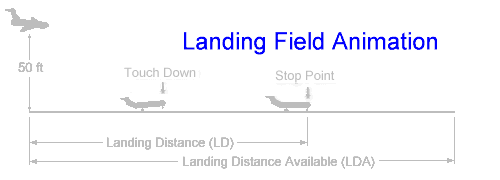
 Typical landing field lengths
 |
EquationsThe landing field length requirement determines an upper limit for the wing loading. The equation for the wing loading is calculated from four basic equations.
1. equilibrium (weight = lift):
|
2. Loftin'statistic: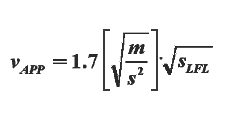
|
3. minimum approach speed: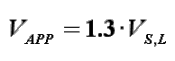
|
4. mass ratio: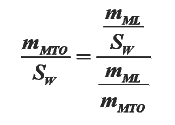
|
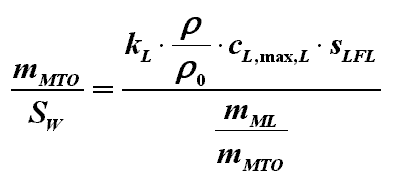
 A click on a variable/equation informs about the background.
Data
A click on a variable/equation informs about the background.
DataThe maximum landing lift-coefficient depends on the type of the high lift systems. Several systems were developed to increase the lift coefficient with the intention to decrease the approach velocity. The values of the lift coefficient range from 1.3 for a clean profil and to 3.0 for a profil with Fowler flaps and slats. Today's aircraft have maximum landing lift-coefficients of around 2.6. For details see e.g. Dubs 1987 or Roskam 1989.
|
Statistics of lift-coefficient |
Typical wing loadingThe wing loadings of existing aircraft are provided below for comparison purposes.
wing loading and approach speed of selected aircraft Jane's 1995-98| Aircraft | Airbus A 300-600B | A 310-300 | A 340-300 | Antonov AN 124 | Boeing B 737-600 | B 777 | Learjet 60 | McDonnell Douglas MD11 | Tupolev TU 204 |
|---|---|---|---|---|---|---|---|---|---|
| Wing loading [kg/m²] | 634.6 | 684.9 | 707.8 | 644.9 | 520.7 | 567.2 | 433.8 | 806.4 | 518.6 |
| Approach speed [m/s] | 69.2 | 69.4 | N/A | 63.8-72.2 | 64.7 | 71.1 | 71.4 | N/A | 61.1 |
 Back to the start page
 |