Technological Institute of Aeronautics
São José dos Campos - São Paulo - Brazil
|
|
Technological Institute of AeronauticsSão José dos Campos - São Paulo - Brazil Requirement 5: Cruise speed |
 Background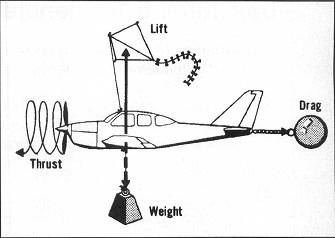
At this condition, the engine thrust (T) must be the same as the drag force (D) and the lift (L) must cancel the weight (W, which is changing because the airplane is burning fuel).
A demanding situation occurs when the aiplane is cruising at MMO (Maximum Operating mach Number) at the service ceiling. This situation is one of those considered for sizing purposes.
Reason to liveWhat we know?
What we must calculate?
EquationsAs explained before, for the cruise condition we have:
T=D and L=W.
However, L and D can be written as
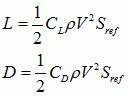
yielding
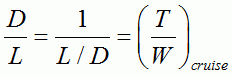
We must rewrite the above equation in order to obtain the desired T0/W0, where T0 is the maximum thrust at takeoff and W0 is the maximum takeoff weight:
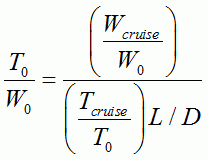
or
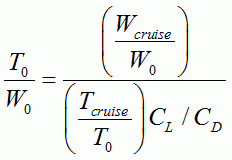
A relation for Tcruise/T0 is provided by Prof. Scholz of Hamburg University of Applied Sciences:

where hcruise is the cruise altitude in km and BPR is the engine by-pass ratio.
If we consider the beginning of cruise, the following relation can be derived according to Roskam's suggested values for mass fractions: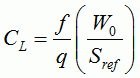
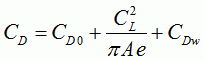

 |
 Swet is obtained in ft2. W0 must
be provided in lb. Swet is obtained in ft2. W0 must
be provided in lb. |
|
Back to the missed approach requirement
Back to the design
diagram |