Technological Institute of Aeronautics
São José dos Campos - São Paulo - Brazil
|
|
Technological Institute of AeronauticsSão José dos Campos - São Paulo - Brazil Requirement 3: Second Segment Climb |
 Background
JAR 25.121 Climb: One-engine-inoperative.
(b) Take-off; landing gear retracted. In the take-off configuration existing
at the point of the flight path at which the landing gear is fully retracted,
and in the configuration used in JAR 25.111 but without ground effect, the
steady gradient of climb may not be less than
2.4 percent
for two-engined airplanes,
2.7 percent for three-engined airplanes, and
3.0 percent for four-engined airplanes,
at V2 and with -
(1) The critical engine inoperative, the remaining engines at the take-off
power or thrust available at the time the landing gear is fully retracted,
determined under JAR 25.111, unless there is a more critical power operating
condition existing later along the flight path but before the point where the
airplane reaches a height of 400 ft above the take-off surface(...); and
(2) The weight equal to the weight existing when the airplane's landing
gear is fully retracted, determined under JAR 25.111.
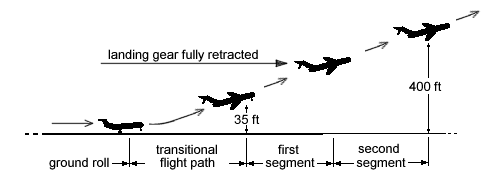
In figure 1 the second segment while the takeoff is presented according to JAR.
 Next: equations for calculation
 |
EquationsThe second segment is based on the situation with one engine of the aircraft inoperative.
Therefore, the thrust of the remaining engine(s) has to be enough to climb as required.
From the equilibrium condition can be got two equations:


Since these equilibrium conditions have to be achieved with one engine inoperative, the required thrust at takeoff with all engines operating has to be higher by a factor N/(N-1). N is the number of engines. The thrust to weight ratio following from the requirement is:

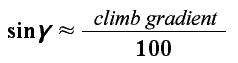
The climb gradient  in the equation above is small. Therefore it can be simplified:
Data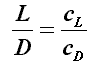

 cD, slat is neglected and set to zero,cD, flap:cD, flap = 0.01cD, flap = 0.02cD, flap = 0.03 .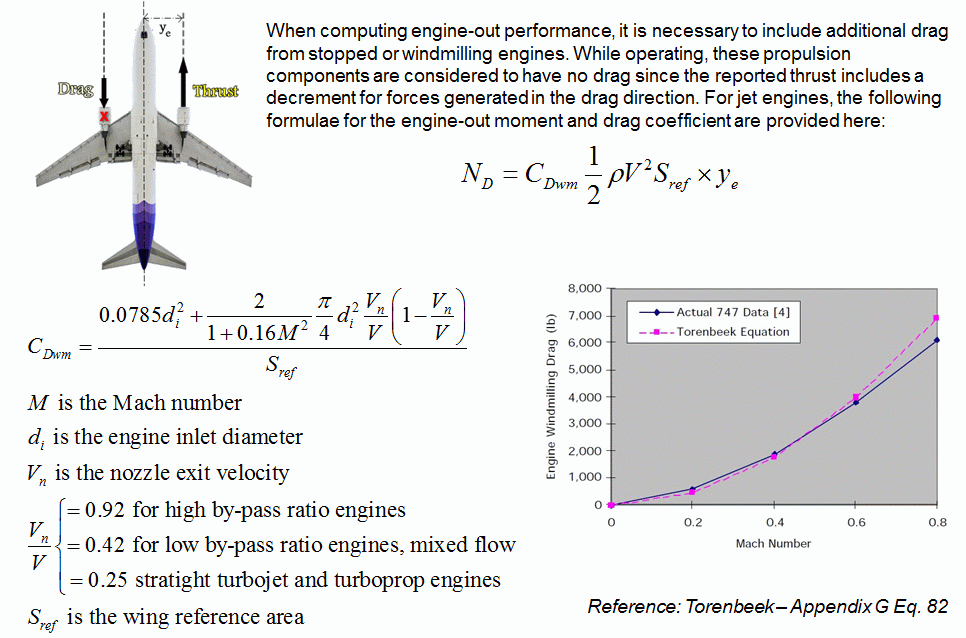
Drag caused by rudder deflection
In order to counterbalance the adverse moment caused by a failed engine, the airplane rudder must be actuated. This causes drag that can be easily accounted by considering the rudder as a plain flap.
Roskam provides a methodology for drag estimation of several flap types.

For plain flaps, the induced and interference components can be discarded. The profile drag is estimated according to the following expression:

The delta term on the right side is obtained from a graph provided by Roskam and, in general, can be assumed to be 0.02. The area relation is the vertical tail-to-wing area ratio and can be assumed to be 0.140 for most jet transport airplanes. Considering an averaged 350 for the quarter-chord sweep angle of the vertical tailplane, a value of 0.0023 or 23 counts is obtained for the drag caused by rudder deflection.
 Statistics of aspect ratio
Equation characters - explanation page
Statistics of aspect ratio
Equation characters - explanation page |
Typical figures for
thrust-to-weight ratio| Aircraft | Airbus A 300-600B | Airbus A 310-300 | Airbus A 340-300 | Antonov AN 124 | Boeing B 737-600 | Boeing B 777 | McDonnell Douglas MD11 | Tupolev TU 204 |
|---|---|---|---|---|---|---|---|---|
| Takeoff thrust Takeoff weight [ - ] |
0.308 - 0.324 | 0.290 - 0.356 | 0.220 - 0.240 | 0.231 | 0.307 | 0.292 - 0.304 | 0.299 - 0.309 | 0.341 - 0.413 |
 Back: takeoff field length requirement
Next: missed approach requirement
Back to design diagram
Back: takeoff field length requirement
Next: missed approach requirement
Back to design diagram |